The Vital truth that needs Mindful approaches – Karma and Trauma
In my book, Dakini Weaving – Keys to the Golden Age, i outlined the Trauma—Karma connection, and here i hope to introduce it to those of you who might be finding that you seem to keep getting stuck with manifestations of trauma, that somehow seem to need treatment beyond current somatic or psychotherapeutic approaches.
This is, without question, a piece in this series I’ve thought hardest about how to frame. Karma and trauma are deeply connected but that connection is exactly the kind of teaching that can be misused, even with good intentions. So before anything else: if you are currently in the middle of processing something traumatic, please know that understanding a pattern “karmically” is never a substitute for real support (a trusted person, a trauma-informed practitioner, or professional care where that’s needed).
What follows is a way of understanding, not a replacement for healing or intervention itself.
Trauma as unresolved karmic residue
One useful way of understanding trauma: it is the residual energy from karmic events that has not left the system. When something happens that overwhelms our capacity to process it in the moment such a shock, a loss, a threat, it doesn’t simply pass through us the way a fully metabolised experience does. It gets stuck: energetically, emotionally, somatically. This stuck quality is what shows up later as fragmentation, hypervigilance, dissociation, looping thoughts, or a body that reacts to the present as though it were still the past.
In this frame, what we call samskaras – our karmically inherited patterns – are often the deeper architecture underneath a trauma response. Not because the event was “deserved,” but because the pattern it left behind is karmic in nature: a seed, still active, still shaping present-moment reactions until it’s consciously met.
Little ‘t’ and big ‘T’ trauma
It helps to know that trauma isn’t only the dramatic, headline version. Clinically, a distinction is often drawn between:
- Big ‘T’ trauma: situations where life or bodily integrity is genuinely threatened such as an accident, an assault, a natural disaster, war.
- Little ‘t’ trauma: the accumulated weight of smaller, more everyday ruptures such as chronic interpersonal conflict, disrupted attachment, repeated small betrayals or humiliations.
Little ‘t’ traumas don’t tend to produce full PTSD on their own, but they absolutely produce real distress and a real decline in quality of life when they accumulate. If what you’ve lived through doesn’t match the scale of what you’ve seen labelled “real trauma” elsewhere, that doesn’t mean it isn’t real, or that it isn’t karmically significant.

A caution – handle with care!
Here is the part I want to be direct about: to tell someone their suffering is simply “their karma” can be genuinely insensitive, especially to someone who has lived through something severe. Karma is not a justification, and it is not a reason to withhold compassion, accountability, or support. Spiritual language – karma, “it was meant to happen,” “everything happens for a reason” – can very easily become a way of bypassing real harm rather than working with it. That’s not a small risk and, in fact, it is one of the most common ways well-meaning spiritual communities cause additional damage to people who are already hurting.
Often spiritual communities can bypass empathic connection through dismissing the manifestations of the systems of trauma – “stop feeling this, it’s just karma.” In reality, it may be more fitting for our contemporary western communities to see for something closer to a Middle Way: neither fixating on trauma as an identity that can never move, nor dismissing it as something that shouldn’t matter because it’s “just karma working itself out.”
Both extremes cause harm. The useful place to stand is between them and taking the pain seriously, offering real acknowledgment and support, and holding the possibility that there is a deeper pattern here that can, in time, be met and transmuted rather than endured forever.
Why acknowledgment comes first
Whatever the karmic framing, the practical sequence rarely changes: acknowledgment before insight. Someone who is still blended with an overwhelming experience, still caught in the fight–flight–freeze–fawn responses of an activated nervous system, is not in a position to hear “this is karma ripening” nor should they be asked to be. The first task is always to help a person feel safe enough, resourced enough, and witnessed enough to be able to decompress, to have the physical, emotional charge of what happened move through and out, rather than staying frozen in the system.
Only once there’s some stability does it become useful and even then, gently to widen the lens: to look at the bigger picture of causality, of pattern, of what this experience might be asking to be understood or released. Rushing this order doesn’t accelerate healing. It just adds a layer of spiritual pressure on top of an already overwhelmed nervous system.
Moving beyond the Drama Triangle
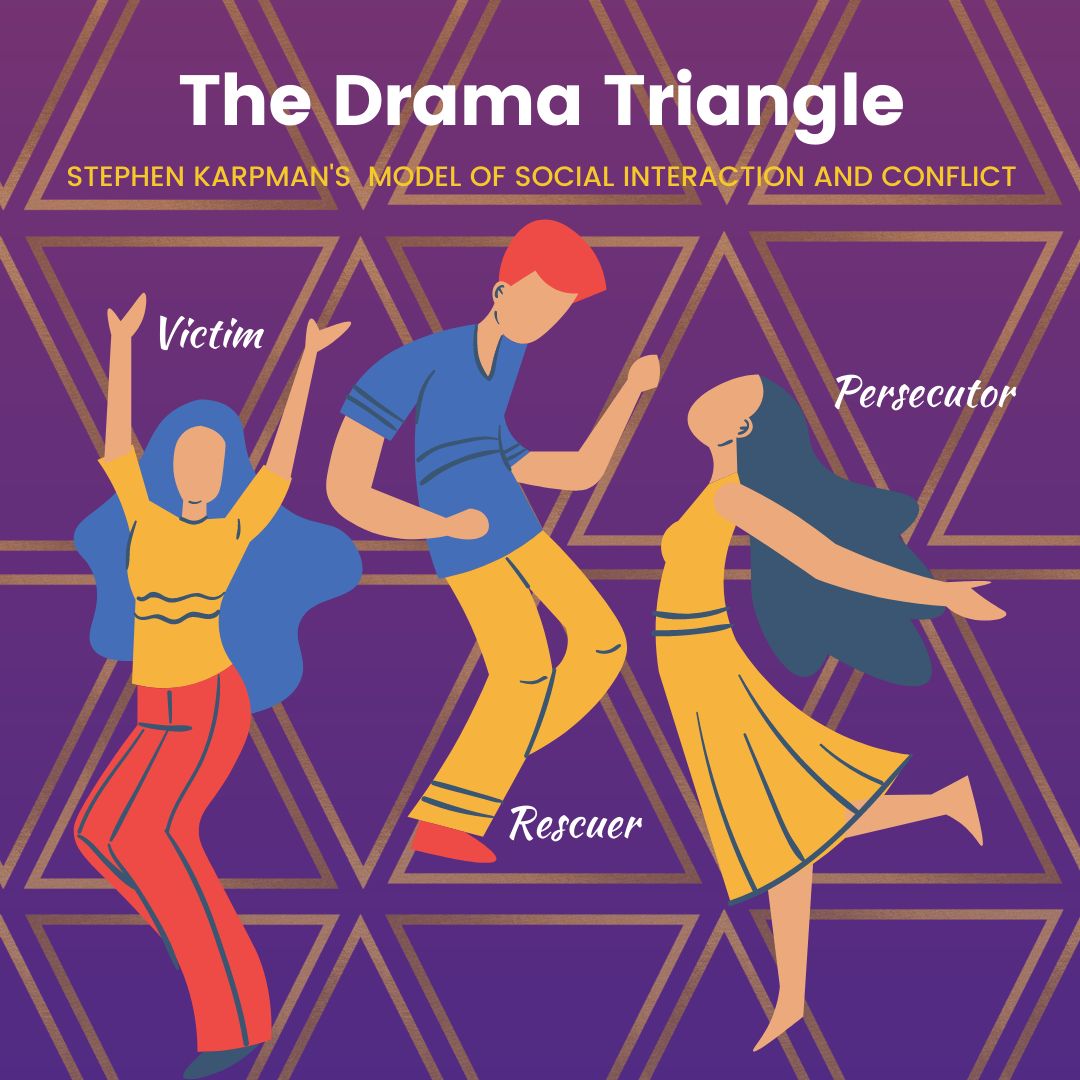
One of the ways unprocessed trauma keeps recurring is through what is sometimes called the Drama Triangle: an oscillation between victim, perpetrator, and rescuer roles that keeps a person locked in duality, unable to see beyond “what was done to me.” Rather than a moral failing this is a natural, protective stage of the healing journey, and it deserves compassion, not correction. But it’s also not the destination. Healing, from this view, means eventually being able to hold what happened without either collapsing into it or remaining locked in opposition to it. It means being able to see the fuller pattern without allowing that wider perspective to minimise what was real.
Where this leads
Understanding trauma as karmic residue doesn’t remove the need for grief, for anger, for real support, or for professional care where that’s appropriate. What it can offer, once there’s enough safety and stability to hold it, is a wider frame: that what has happened is not meaningless, that the nervous system’s response makes complete sense, and that there is a path from being pummelled by a pattern to eventually, consciously, releasing it.
If this piece resonates and you’re looking for more structured support with this work, that’s exactly what our karma – trauma-informed modalities, courses and short mini courses are there for.
Ready to go deeper?
If any of this resonates, there are a few gentle ways to explore it further, at whatever pace feels right:
Karma Workshop — Learn more →
Karma & trauma work — Fundamentals in Trauma-Informed Modalities course: an overview of numerous trauma-informed therapies, tools and approaches to give you a multi-layered understanding of how trauma can be tackled from different vantage points and with diverse client needs. Learn more →
Indigenous Science, Dharma & Karma — ‘Natural Law, Indigenous Science, Karma and Dharma’ is a single module of our Dakini Weaving Training Level 1, a potent gateway for budding change makers, yogis and bodhisattvas who wish to gain holistic knowledge of the path to the Higher timeline and the Golden Age. Learn more →
Metaphysical mentoring — ongoing guidance for the walk from karma to dharma. Learn more →
A personal reading — a chart-based look at the karmic conditions behind a pattern. Book a reading →
Timeline & Quantum Transfiguration guidance — support navigating personal and collective timeline shifts. Learn more →


