What Karma Actually Is (and Isn’t)
In the West, we often have a rather muddy perspective on what karma is, and this means that often we don’t progress far on our path because of this limited understanding of causality.
Karma has become one of those words that gets used so loosely it barely means anything anymore. “That’s just karma.” “Karma’s going to get them.” It’s shorthand, in popular use, for a kind of cosmic scorekeeping, a moral bookkeeping with a payout date.
That’s not what karma is. The misunderstanding isn’t harmless but it tends to produce either fear (a vague sense of being watched and judged by the universe) or a strange passivity (waiting for karma to “handle” things rather than acting). Neither is useful. So let’s start with what karma actually describes.
In Vedic and Buddhist traditions, a deeper understanding of karma enables practitioners to use the opportunities of ‘karmic ripening’ and also to realise what we do and do not have any agency over.
In this series we look at karma, as a way to help you prepare for deeper workshops, readings, self-inquiry and hopefully a migration from being ‘karma-riddled’ to ‘dharma-driven’.
Before we go any further into this series – into time, types, trauma, astrology, and the long road from karma to dharma – it’s worth pausing on the word itself. Karma means action.
The word itself, from Sanskrit, simply means action. Not fate, not punishment, not a moral ledger being kept somewhere in the sky. Karma refers specifically to the effects generated by our actions of body, speech, and mind – what we do, what we say, and even what we think and rehearse internally.
This is Natural Law’s principle of causality, and it has two components worth understanding clearly:
- Substantial cause: the actual substance from which an effect arises. A seed becoming a flower is the classic image; the seed doesn’t merely precede the flower, it is the flower in potential.
- Supporting conditions: everything else that has to be present for a particular result to occur. The seed alone isn’t enough; it needs soil, water, light, and time.
Karma works the same way: an action is the seed. But whether, when, and how it ripens depends on a whole field of supporting conditions, which is part of why karma can feel so unpredictable and why cause and effect aren’t always visible in a straight line.
Every action plants a seed
Here’s the part that tends to land hardest and causes aversion to a deeper path of self realisation is that every time we engage in a particular action of body, speech, or mind, we’re reinforcing a habit. Every time we react a certain way, we increase the probability we’ll respond the same way again. This is what’s meant by a karmic seed – rather than a mystical abstraction is something closer to how neural pathways strengthen with repetition. The difference is that the mind, being non-physical in this sense, doesn’t have a natural process of atrophy the way unused muscle does. Once a seed is sown, it stays until it ripens as an experience, or is deliberately weakened by a counter-force.
This means karma isn’t primarily something that happened to you long ago. It’s something you’re actively creating, right now, with this thought, this reaction, this word. We are always creating new karma (unless we attain a very high level of spiritual mastery). There’s no pause button. Even the choice to do nothing is itself an action with consequence.
Samsara: the wheel, not the punishment
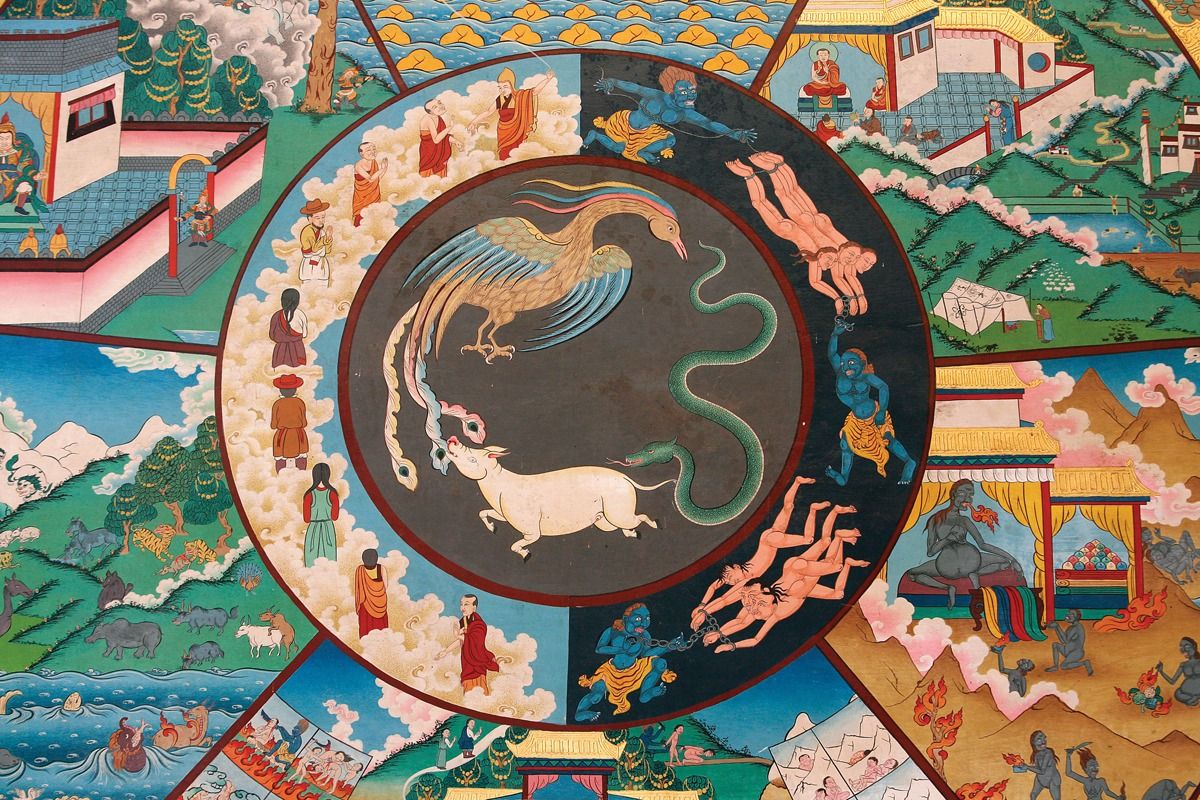
The teaching traditions that map karma most carefully – Buddhism and the Vedic sciences in particular – describe the result of unconscious, repeated karmic patterning as samsara: often pictured as a wheel, or, less poetically, a hamster running on it. Samsara isn’t a place you’re sent as punishment, it’s simply what happens when karmic seeds keep sprouting into the same habitual responses, life after life, without anyone noticing the pattern well enough to step outside it.
Why this reframing matters? It shifts karma from something done to you to a pattern you have real agency inside of, which is a very different and much less disempowering place to stand.
Karma and dharma, briefly
We’ll go much deeper into this pairing later in the series, but it’s worth naming now: karma and dharma aren’t opposites. Dharma is what karma matures into when it’s met with awareness rather than reactivity: right action, aligned with a deeper purpose rather than habitual pattern. Karma points to what has shaped us and dharma points to what we do with that shaping. You can’t skip karma to get to dharma, you work through it.
Why this foundation matters
Every piece that follows in this series – karma and time, the different types and “fixedness” of karma, karma’s relationship to trauma, what a birth chart actually shows us about our karmic conditions, and finally the turn from karma to dharma – rests on this simple reframe: karma is cause and effect in motion, not a verdict already handed down.
You are not a passive recipient of karma: you are, every day, one of its authors.
A question to sit with
Before the next piece, a simple practice: notice a moment where you feel a habitual reaction rising – the same old response to the same old trigger. Don’t try to stop it. Just notice that you’re watching a seed you planted, once, still sprouting. That noticing, on its own, is the beginning of a different relationship with your own karma. When you start to understand that karma is arising or ripening, the very act of being observant of this changes your relationship to it, and may actually even mark the end of that propensity.
At Dharma STARS we are committed to helping people move from overwhelm and being pummelled endlessly by their karma to being beacons of a Golden Age by stepping into their Highest Dharma, and we hope, ultimately to Liberation—Moksha!
Ready to go deeper?
If any of this resonates, there are a few ways to explore it further:
A personal reading — a chart-based look at your own karmic seeds and what they’re sprouting into. Book a reading →
Karma & trauma work — 1:1 or course support for what’s held in the body and nervous system. Learn more →
Metaphysical mentoring — ongoing guidance for the walk from karma to dharma. Learn more →
Timeline & Quantum Transfiguration guidance — support navigating personal and collective timeline shifts. Learn more →


